
Thermal Receipt Paper Guide: Sizes, Roll Fit, and BPA-Free Options
Posted by Thermal Printer Supplies on Nov 10th 2026
Receipt Paper · Buying Guide | By Thermal Printer Supplies
Last reviewed November 10, 2026
In This Post
Receipt paper looks simple until you order the wrong roll. Width is only the first number. The roll also has to fit the printer's paper bay, sit on the right core, and be the right kind of paper for the printer. Here's how to read a roll size, pick the right width, decide on BPA-free or phenol-free paper, and stock enough for the holiday rush.
Receipt Paper Quick Facts
- Most common size: 3 1/8 inch (sold as 80 mm) for countertop POS receipt printers.
- Card terminals and mobile printers: usually 2 1/4 inch (sold as 57 or 58 mm).
- Three numbers to match: width, roll outside diameter, and core size. Length only tells you how long the roll lasts.
- Thermal vs. bond: thermal printers need thermal paper. Kitchen impact printers use plain bond paper and a ribbon.
- Fading: heat, sunlight, vinyl sleeves, and hand sanitizer all fade thermal receipts. Store rolls cool, dry, and in the dark.
November and December are when registers burn through paper fastest, and when a wrong-size case hurts the most. A roll that's a hair too wide won't drop into the printer. One that's too big around won't let the cover close. And a roll of bond paper in a thermal printer just prints blank. A few minutes with the numbers below saves a return and a rush order.
Start Here
Picking the Right Receipt Paper Width
What Size Receipt Paper Do I Need?
If it's a countertop receipt printer next to a register, it almost certainly takes 3 1/8 inch paper. If it's a handheld card terminal or a small mobile printer, it's usually 2 1/4 inch. The fastest way to be sure is to pull out the current roll and measure the paper edge to edge, or look up your printer model in its manual. The width has to match exactly.
POS printers
3 1/8 in (80 mm)
The standard for countertop receipt printers like the Star TSP100 and TSP650 and the Epson TM-T88 series. Common lengths run from about 200 to 300 feet, with longer rolls for printers that take a bigger roll.
Shop 80 mm rolls →Terminals and mobile
2 1/4 in (57 to 58 mm)
Used in credit card terminals, handheld POS devices, and compact 58 mm receipt printers. Rolls are short, often 50 to 85 feet, because the paper bay is small.
Shop 58 mm rolls →Check twice
3 in Bond and Specialty
Kitchen impact printers usually take 3 inch bond paper with an ink ribbon, not thermal paper. Outdoor fuel pump printers use their own widths and outdoor-rated paper. Match the printer, not the shape of the roll.
3 1/8 inch and 80 mm are the same size, sold under two names. The same goes for 2 1/4 inch and 57 or 58 mm. Don't let the label on the box throw you.
Roll Fit
Making Sure the Roll Fits Your Printer
What Do the Numbers on a Receipt Paper Roll Mean?
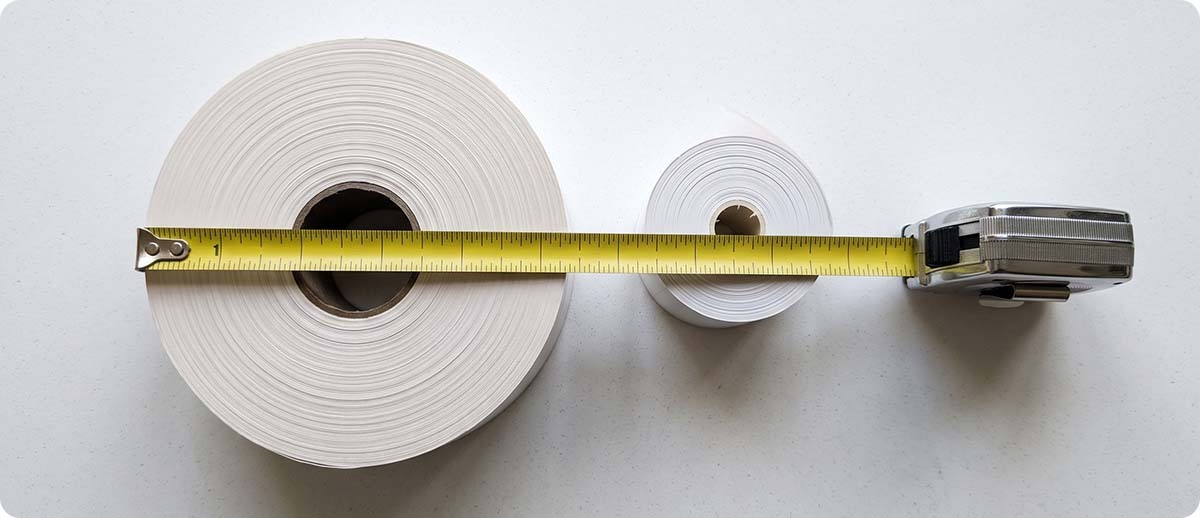
A size like "3 1/8 x 230" means the paper is 3 1/8 inches wide and 230 feet long. Most listings also give two more numbers that matter just as much: the roll's outside diameter (how big around it is) and the core size (the hole in the middle). Width decides whether the paper fits through the printer. Diameter decides whether the roll fits in the paper bay. Core decides whether the roll sits and feeds properly.
How Do I Know What Roll Diameter My Printer Takes?
Check the printer's spec sheet or manual for "maximum roll diameter," and buy rolls at or under that number. Two rolls with the same width can have very different diameters, because longer rolls are wound bigger. For example, the 80 mm x 230 foot Star rolls we carry for the TSP100 and TSP650 measure 3.27 inches across. If a printer only takes a smaller roll, a longer roll simply won't fit, no matter how good the price is.
Does Core Size Matter for Receipt Paper?
Less than it does for labels, but yes. Most drop-in receipt printers hold the roll loosely in a bay, so the core mainly affects how the roll spins and how much paper is left at the end. Printers that mount the roll on a spindle need the core to match the spindle. Our post on why core size matters covers this for label printers, where it's a much bigger deal.
Compare
Common Receipt Paper Sizes at a Glance
Which Receipt Paper Size Goes With Which Device?
| Width | Also Sold As | Paper Type | Typical Devices |
|---|---|---|---|
| 3 1/8 in | 80 mm | Thermal | Countertop POS receipt printers (Star TSP100, TSP650, TSP700; Epson TM-T88) |
| 2 1/4 in | 57 or 58 mm | Thermal | Credit card terminals, handheld POS, compact 58 mm printers |
| 3 in | 76 mm | Bond (with ribbon) | Kitchen impact printers |
| 2 5/16 in | About 59 mm | Outdoor-rated thermal | Fuel pump printers |
On a phone, swipe the table sideways to see every column. Always confirm width and maximum roll diameter in your printer's manual.
Paper Grades
BPA-Free, Phenol-Free, and Other Paper Choices
What Is BPA-Free Receipt Paper?
BPA-free receipt paper is thermal paper made without bisphenol A, a chemical that has long been used as the developer that makes the image appear when the printhead heats the paper. Many retailers switched because employees handle receipts all day. The catch is that "BPA-free" doesn't say what was used instead. A lot of BPA-free paper uses BPS, a close chemical cousin. In its 2015 study of alternatives, the U.S. EPA found no clearly safer drop-in replacement among the developers it looked at, BPS included.
What Is the Difference Between BPA-Free and Phenol-Free Paper?
Phenol-free paper goes a step further: it avoids BPA, BPS, and the other phenol-based developers. If your company has a policy against bisphenols, or you're writing a spec for a chain of stores, ask for phenol-free, not just BPA-free. It usually costs a little more. It prints the same way in a standard thermal receipt printer.
Need to know whether a specific roll is BPA-free or phenol-free? Contact our customer service team and they'll check the paper spec for you before you order.
Do I Need Top-Coated Receipt Paper?
Only if the receipt has to last or take abuse. Standard thermal paper is fine for everyday customer receipts. Top-coated paper adds a protective layer that holds up better to heat, moisture, oils, and handling, and it keeps its image longer. That makes it worth it for receipts customers keep for returns or warranties, pickup tickets that ride on hot food bags, and outdoor printers. The same idea applies to thermal labels, which our post on direct thermal vs. thermal transfer covers.
Can a Receipt Printer Print Labels Too?
Some can. Certain Star printers are built to run linerless (sticky-back) receipt paper, which is handy for takeout and delivery bag labels. A regular receipt printer can't, and gummed paper in the wrong printer makes a mess. If you're trying to decide whether you need a receipt printer, a label printer, or both at the counter, our guide to receipt printers vs. label printers at checkout walks through it.

Buy Right
How Much Receipt Paper to Order
How Many Receipts Are on a Roll?
Divide the roll length by your average receipt length. A 230 foot roll is 2,760 inches of paper. If your average receipt runs 7 inches, that's roughly 390 receipts per roll. A 50 foot terminal roll at 5 inches per receipt gives about 120. To find your own average, print a typical receipt and measure it, logo and footer included. Long receipts with coupons or surveys can cut a roll's life in half.
Print a typical receipt and measure its length in inches.
Pull your transactions per day at each register from your POS reports, using a busy day, not an average one.
Receipt length times transactions times days, divided by the roll length in inches. That's how many rolls you need. Add a buffer for reprints and gift receipts.
How Much Receipt Paper Should You Stock for the Holidays?
Plan for your busiest weeks, then add a cushion. Run the math above with your peak-day transaction count, and cover at least six to eight weeks through the end of the return season in January, when gift receipts and exchanges add paper of their own. Keep a few rolls at each register, so nobody walks to the back office mid-rush. If you buy by the case, check how many rolls are in it: our 80 mm x 230 foot Star rolls come 50 to a case.
How Should You Store Receipt Paper?
Keep it cool, dry, and out of the light, in its original packaging until you need it. Thermal paper reacts to heat even before it's printed, so a case left near a window, a heater vent, or a hot delivery truck can gray out or print faint. Once printed, receipts fade faster when they touch vinyl (wallet sleeves, binder pockets), plastic wrap, oils, or alcohol-based hand sanitizer. That's worth telling customers who keep receipts for warranties.
FAQ
Quick Questions
Why Is My Receipt Printer Printing Blank Receipts?
The roll is most likely loaded backward. Thermal paper only prints on its coated side, which has to face the printhead. Scratch the paper with a fingernail: the side that leaves a dark mark is the coated side. If both sides stay white, you may have bond paper, which won't print in a thermal printer at all.
Is 80 mm Paper the Same as 3 1/8 Inch Paper?
Yes. They're the same width. 3 1/8 inches works out to just under 80 mm, and suppliers use both names for the same rolls. Still check the roll diameter, since that's what changes from one length to the next.
Why Do My Receipts Print Faint or Streaky?
Old or heat-damaged paper is a common cause, so try a fresh roll from a different case first. If that doesn't fix it, the printhead may need cleaning, or a worn roller may not be pressing the paper evenly against the head. Our post on the platen roller explains how to spot that.
The right receipt paper comes down to three numbers and one choice: width, roll diameter, core, and the paper grade your business wants. Get those right and your registers stay running straight through the holidays. If you're not sure which roll fits your printer, or you have questions about BPA-free or phenol-free paper, the customer service team at Thermal Printer Supplies can help. You can browse our receipt paper in the meantime, or request a quote on case quantities.
Keep Reading
Customers Also Checked These Out