
Linerless Labels: Calculating the ROI of Zero-Waste Printing
Posted by Thermal Printer Supplies on Apr 17th 2026
By Thermal Printer Supplies | Linerless Printing | ROI & Cost Analysis Guide
Approximately 370,000 tons of label liner ends up in US landfills every year. That number is striking, but it's not what drives purchasing decisions in warehouses, distribution centers, food processing facilities, and retail operations. What drives purchasing decisions is whether switching to linerless labels actually reduces cost, increases throughput, or both — and whether the improvement is large enough to justify the investment in new printer hardware or conversion kits.
The answer depends almost entirely on volume and workflow. At low label volumes, the case for linerless is primarily environmental. At medium-to-high volumes — typically 1,000 or more labels per day per printer — the operational and material cost savings accumulate into a genuine financial case that typically pays back printer investment within 12-24 months. At very high volumes in e-commerce fulfillment, food processing, or logistics environments, the ROI is often faster.
This guide breaks down each of the five ROI drivers — material cost, storage, disposal, labor, and throughput — gives you a framework for estimating your operation's specific savings, covers where linerless doesn't make the financial case, and identifies the Thermal Printer Supplies hardware that supports each deployment type.
How Linerless Works — The Quick Version
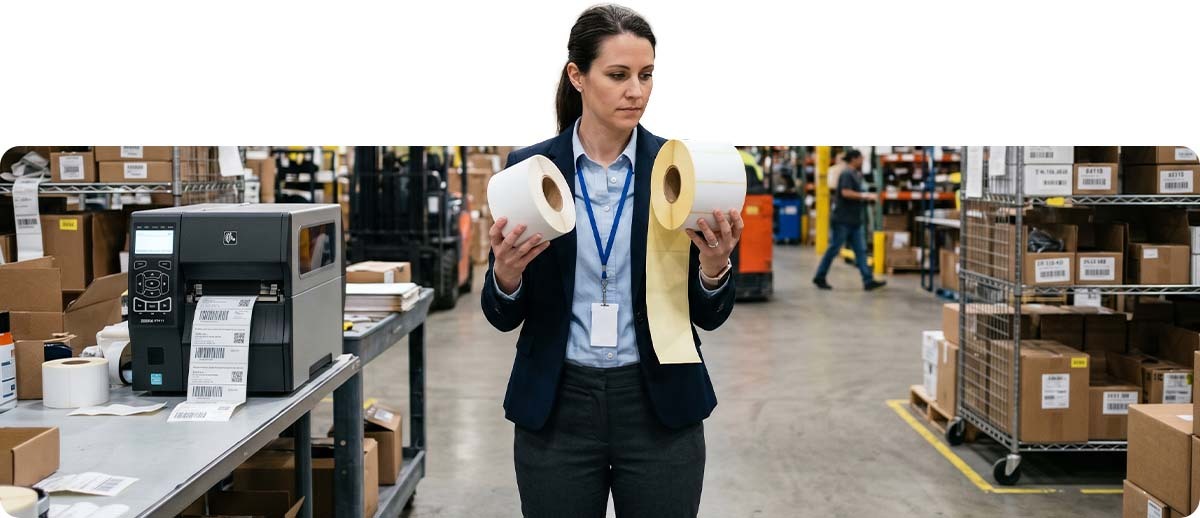
Traditional pressure-sensitive labels are supplied on a silicone-coated liner — the backing paper that gets peeled off and discarded after application. The liner exists solely to protect the adhesive until the label is applied. After use, it goes in the trash. It cannot be recycled due to its silicone coating. Every label roll you use generates a corresponding roll of liner waste.
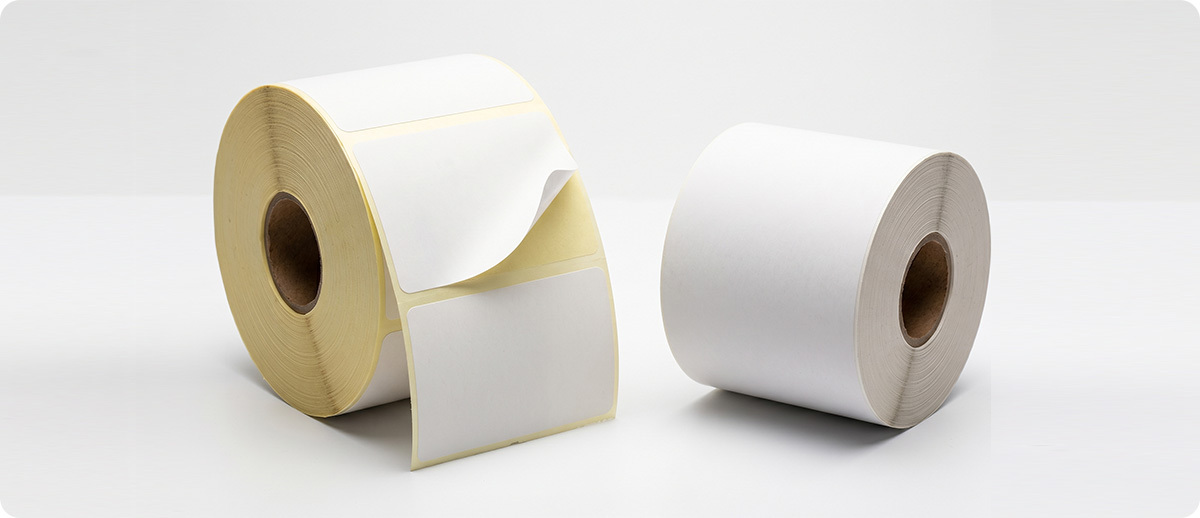
Linerless labels eliminate the liner entirely. The roll uses a silicone release coating on the face of the label material itself — the same function, built into the facestock — which prevents the adhesive layer from sticking to the label above it on the roll. A linerless-capable printer uses a silicone-coated platen roller (instead of the standard rubber roller) to prevent adhesive buildup, plus a cutter that cuts the continuous roll to length after printing. The label exits the printer ready to apply, with no liner to peel or discard.
Because there's no liner taking up space on the roll, a linerless roll carries significantly more label material in the same physical roll diameter. That's the first and most direct ROI driver — and it cascades into several others.
ROI Driver #1: More Labels Per Roll — The Foundation of the Math
Linerless rolls hold up to 50% more labels than a comparably sized traditional roll, depending on label thickness and dimensions. The liner on a conventional label roll typically accounts for 40-50% of the roll's total weight and a meaningful portion of its diameter. Remove the liner and you can wind significantly more label material onto the same core in the same outer diameter.
What this means in practice: if your operation currently uses 20 conventional rolls per day at a given label size, the same daily volume might require 13-14 linerless rolls. That's 6-7 fewer rolls purchased, received, stored, and changed per day. Multiply by 250 working days and by the number of printers in your operation, and the material savings are meaningful before you account for any other benefit.
The math framework: Take your current daily roll consumption per printer. Multiply by 250 working days to get annual rolls. Multiply by your per-roll cost. Then multiply that figure by 0.35 (a conservative 35% fewer rolls at linerless parity pricing) to get a rough annual material savings estimate per printer. At $15/roll and 10 rolls/day, that's $37,500 in rolls per year — a 35% reduction puts $13,000+ in annual savings on the table from material cost alone, per printer.
Note: linerless media typically prices slightly higher per roll than equivalent conventional stock. The net material savings comes from needing fewer rolls, not from a lower per-roll price. When properly accounted, operations running high volumes consistently see net material cost reductions of 20-30% after accounting for the price differential.
ROI Driver #2: Reduced Storage Footprint
Label media storage is a cost that rarely appears in a printer selection analysis but is real in any operation storing significant label inventory. Studies by Ravenwood Packaging found a 40% reduction in label roll weight with linerless conversion — which directly translates to 40% less storage weight and volume for the same label capacity. For operations maintaining weeks of label inventory on-site, this is shelf space, warehouse space, and receiving dock throughput.
The secondary benefit is supply chain simplification. Fewer rolls ordered means fewer purchase orders, fewer deliveries, fewer receiving transactions, and less inventory management overhead. For multi-site operations coordinating label supply across multiple facilities, the procurement and logistics simplification is a non-trivial operational benefit even before the direct cost savings.
ROI Driver #3: Liner Disposal Cost Elimination
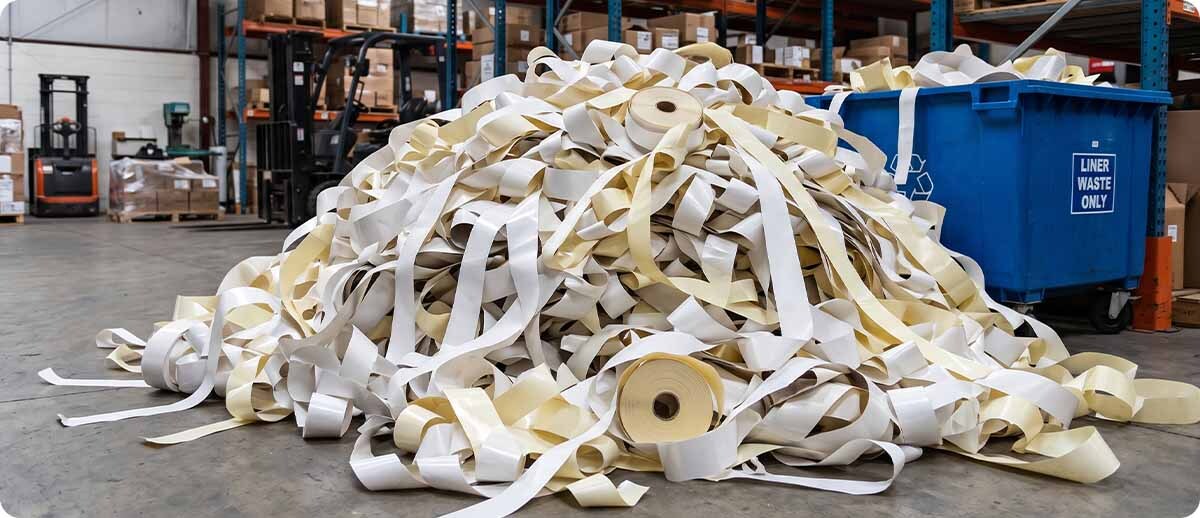
Liner waste disposal has a direct cost that operations often undercount because it's embedded in general waste hauling rather than attributed to the label operation specifically. Silicone-coated liner cannot go to standard paper recycling — the silicone contamination makes it non-recyclable in most municipal programs. It goes to general waste, which means landfill.
High-volume operations generate meaningful tonnage of liner waste annually. At 10 rolls per day, 250 days per year, the liner from a single conventional label printer represents hundreds of pounds of non-recyclable silicone-coated paper annually. Multiply across a fleet of 20 or 50 printers in a distribution center or food processing plant and the disposal cost — both in direct hauling fees and in landfill diversion compliance for operations with sustainability mandates — becomes a budget line worth tracking.
Some operations in regulated industries (food and beverage, pharmaceutical, consumer goods) face supplier sustainability scorecards and packaging waste targets from major retail customers. Linerless conversion directly reduces the packaging waste metric that gets reported to these customers — which has a compliance value beyond the direct cost of liner disposal.
ROI Driver #4: Labor Savings from Fewer Roll Changes
Every conventional label roll change involves stopping the printer, removing the spent roll and its liner core, loading the new roll, threading the media, and recalibrating if necessary. At a few minutes per change, across multiple printers running multiple shifts, roll change labor accumulates. Industry analysis estimates that linerless operations save approximately 20% of label-related machine downtime from fewer roll changes — which in a high-throughput pick-and-pack or food labeling line translates directly to throughput.
The math: if a printer in your operation is changed 10 times per day at 3 minutes per change, that's 30 minutes of production time per printer per day. Across 250 days, that's 125 hours per printer annually. At 35% fewer roll changes with linerless, you're recapturing 44 hours per printer per year. Multiply by labor cost and the number of printers in your fleet to get the labor ROI from this driver alone.
In mobile printing applications — workers carrying a printer through a warehouse or distribution center — roll change labor is even more significant because the worker must stop their workflow, often return to a supply station, and reload before resuming. Fewer roll changes per shift on a mobile linerless printer directly extends productive picking or scanning time.
ROI Driver #5: Variable Label Sizing — Eliminating Label SKU Proliferation
This is the ROI driver that gets the least attention and often delivers the most operational value in the right environment. Linerless labels are cut to length at the printer — the cutter determines label length based on the print job, not a pre-die-cut format on the roll. An operation currently managing eight different label sizes for different products, shipping destinations, or applications may be able to consolidate to one or two linerless roll widths.
The operational implications: fewer label SKUs to order, receive, stock, and track. Reduced risk of printing on the wrong pre-cut label format. No waste from pre-cut labels that are slightly too large for the content being printed. In e-commerce fulfillment specifically — where pack contents vary by order and packing slip length varies accordingly — linerless variable-length printing on a single roll width can replace a multi-SKU conventional label inventory with a single stock item.
Toshiba's DL1024 industrial linerless printer is specifically designed to exploit this: it merges shipping labels and packing slips into a single variable-length format, with documented printing cost reductions of approximately 40% versus maintaining separate label and document printing operations. This is a specific application where the variable-length benefit is the primary value driver.
Where Linerless Doesn't Make the Financial Case
Linerless is not the right answer for every operation, and being honest about where it doesn't pencil out is as important as the ROI case above.
Low-volume operations printing fewer than 200-300 labels per day will see minimal financial benefit. The material savings on a small number of rolls don't justify a printer hardware investment, and the labor savings from fewer roll changes are negligible at low volume. The environmental benefit is still real, but the financial case isn't compelling at low volumes.
Operations requiring die-cut label shapes. Linerless labels cut from a continuous roll into rectangles. If your application requires oval, round, or irregularly shaped labels — common in cosmetics, food packaging, and product branding — linerless is not currently viable. Die-cut shapes require conventional liner-based labels.
Thermal transfer applications requiring resin or wax-resin ribbons. Linerless labels are direct thermal — they print via heat on heat-sensitive facestock without a ribbon. Applications requiring the durability of thermal transfer printing (chemical drum labels, outdoor asset tags, compliance labels requiring resin ribbon) are not appropriate for linerless media.
Applications requiring very long-duration label life. Direct thermal linerless labels are subject to the same thermal image limitations as other direct thermal media — images can fade with prolonged UV exposure or heat. For labels that need to survive years of outdoor exposure or high-temperature environments, thermal transfer on conventional media is the more durable option.
Operations with significant existing conventional printer infrastructure and limited capital budget. Converting to linerless requires either new linerless-capable printers or conversion kits for existing models. If your current conventional printer fleet is recent and fully depreciated, the printer investment required for linerless conversion may delay the financial breakeven. The decision is better framed as: when replacing printers anyway, linerless-capable models should be the default selection for high-volume applications.
The Linerless Hardware at Thermal Printer Supplies
The right linerless printer depends on your daily volume, application environment, and whether the deployment is fixed or mobile. Here is the full linerless-capable lineup available at Thermal Printer Supplies, organized by use case.
Industrial Fixed — For High-Volume Production and Distribution
Zebra ZT411 Linerless Industrial Printer
Part #: ZT41142-D910000Z | 4" direct thermal | 203 DPI | Linerless cutter
The ZT411 is Zebra's industrial-grade linerless workhorse — all-metal frame, 24/7 duty cycle, built for the volumes where linerless ROI is most compelling. Linerless cutter configuration built in. Up to 14 inches per second. Full Zebra Print DNA suite via Link-OS for remote management across printer fleets. The right choice for high-volume fixed-station applications in distribution, food processing, manufacturing, and retail back-office environments where uptime and throughput are the primary metrics.
Shop ZT411 Linerless →Toshiba DL1024 Industrial Linerless Printer
Part #: DL1024-P | 4" | 200 DPI | 6 IPS | ZPL compatible
Toshiba's purpose-built industrial linerless printer, designed specifically for e-commerce fulfillment and shipping applications where the variable-length advantage is most valuable. The DL1024 merges shipping labels and packing slips into a single variable-length print job — documented at approximately 40% lower printing cost versus separate label and document printing. ZPL compatible for straightforward integration with existing label software. The right choice for e-commerce operations evaluating the variable-length ROI driver specifically.
Shop Toshiba DL1024 →Desktop Fixed — For Office, Back-Room, and Mid-Volume Applications
Zebra ZD621 Linerless Desktop Printer
Part #: ZD6A142-D41L01EZ (Wi-Fi/BT) | ZD6A042-D41F00EZ (wired) | 4" | 203 DPI | Linerless with cutter and label taken sensor
Zebra's premium desktop linerless solution — the ZD621 with linerless configuration includes both a cutter and a label taken sensor, which confirms the printed label has been removed before cutting the next one. Color touch display option for simplified operation. Link-OS for remote management. Available in both wired and wireless (802.11ac/BT) configurations. The right choice for back-office, retail, pharmacy, and mid-volume distribution applications where a desktop form factor is appropriate but linerless throughput benefits are wanted.
Shop ZD621 Linerless →Zebra ZD611 Linerless Desktop Printer
Part #: ZD6A023-D41B01EZ | 2" | 300 DPI | Linerless with cutter and label taken sensor
The ZD611 linerless in 2-inch format for applications requiring a compact desktop linerless solution — pharmacy, laboratory, small parts identification, and retail environments where counter space is a constraint. 300 DPI for clean print on smaller label formats. Link-OS compatible. Linerless with cutter and label taken sensor. The compact linerless option when 4-inch width is more than the application requires.
Shop ZD611 Linerless →Star Micronics mC-Label3 Linerless Printer
Part #: 39658310 | 3" | Label and linerless | LAN, USB-C, Bluetooth | iOS/Android/Windows
Star Micronics' compact desktop linerless solution with USB-C power delivery — simultaneously powers and communicates with iOS, Android, and Windows devices without a separate power adapter. Adjustable width up to 3 inches for flexible media compatibility. CloudPRNT and SteadyLAN for cloud and wired-to-mobile connectivity. The right choice for retail, hospitality, and food service applications where linerless label and receipt printing from mobile devices or POS terminals is needed in a compact footprint.
Shop Star mC-Label3 Linerless →Epson TM-L100 Linerless Printer
Part #: C31CJ52A9991 | 40/58/80mm media | Wi-Fi, USB-A, Ethernet
Epson's OmniLink linerless label printer for hospitality, retail, and food service applications. Supports 40, 58, and 80mm media widths for flexible label sizing across applications. Simultaneous sharing with PC-POS terminals, mobile devices, and cloud servers. USB-Network-Tethering for wired network connection through a mobile device. Designed for buy-online-pickup-in-store, curbside pickup, delivery, and cup-and-item labeling workflows where a compact, connected linerless printer is the right solution.
Shop Epson TM-L100 Linerless →Mobile — For On-The-Go and Forklift-Mounted Linerless Printing
Zebra ZQ630+ Linerless Mobile Printer
Part #: ZQ63-AUWB004-00 (dual 802.11ac/BT) | ZQ63-AUFB004-00 (BT only) | 4" | Linerless platen
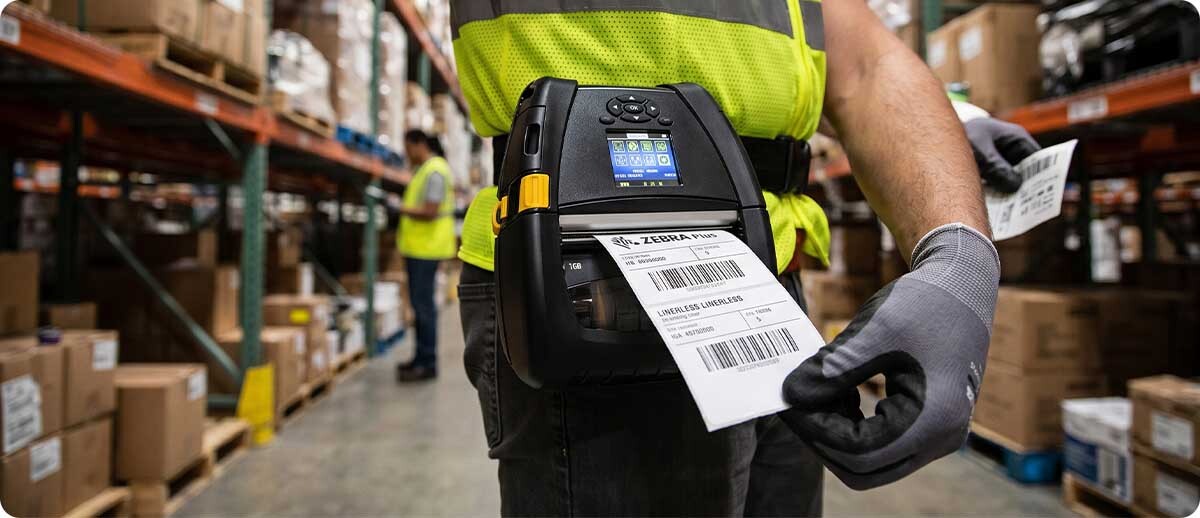
Zebra's 4-inch mobile linerless printer for warehouse, logistics, and field service applications. The linerless platen configuration eliminates liner disposal in mobile environments — particularly valuable in picking operations where liner accumulation on the floor is a safety and housekeeping issue. Belt clip for hands-free carrying or forklift mounting. Advanced battery technology with instant wake-on status. 802.11ac and Bluetooth. The mobile linerless solution for operations that need high-volume on-demand label printing without liner waste throughout a facility.
Shop ZQ630+ Linerless →Zebra ZQ620+ Linerless Mobile Printer
Part #: ZQ62-AUWB004-00 | 3" | Dual 802.11ac/BT | Linerless platen
The 3-inch mobile linerless version for applications where a slightly more compact printer is preferred — courier and last-mile delivery, retail floor labeling, and light warehouse applications. Same Zebra mobile platform as the ZQ630+ with linerless platen, dual wireless, and advanced battery management in a slightly smaller form factor.
Shop ZQ620+ Linerless →Linerless Label Media
Zebra 8000D Linerless Label
Part #: LD-R2LS5W (2" x 65') | LD-R4LF5P-R (4" x 85') | Compatible with ZQ610, ZQ620, ZQ630, QLn series
Zebra's certified 8000D linerless label media — premium direct thermal, bright white coated paper, high-tack permanent acrylic adhesive designed for small and curved surfaces. Survives temperatures as low as -75°F for cold chain and freezer applications. Requires linerless roller. Available in 2-inch and 4-inch widths. Zebra-tested and recommended for Zebra ZQ610, ZQ620, ZQ630, QLn220, QLn320, QLn420, and RW420 mobile printers. The certified media choice for Zebra mobile linerless deployments.
Shop Zebra 8000D Linerless Labels →Your Linerless ROI Estimate — A Simple Framework
Use this framework to generate a rough ROI estimate for your operation. The numbers won't be exact — they depend on your specific media pricing, labor rates, and disposal costs — but they give you a basis for evaluating whether linerless justifies further investigation.
| ROI Driver | How to Estimate | Typical Range |
|---|---|---|
| Material savings | Annual rolls × cost/roll × 25-35% reduction | 20-35% of media spend |
| Labor savings (roll changes) | Daily changes × 3 min × 35% reduction × 250 days × hourly rate | 40-80 hrs/printer/yr |
| Disposal cost reduction | Annual liner weight × waste hauling cost/ton | Varies by fleet size |
| Storage cost reduction | Inventory reduction × cost of storage space/sq ft | 40% less roll weight |
| Variable-length consolidation | Number of label SKUs eliminated × procurement overhead saved | High where applicable |
Sum these five drivers and compare against the cost of the linerless printer hardware (or conversion kit if converting existing compatible hardware). Most operations running 1,000+ labels per day per printer find payback within 12-24 months. High-volume e-commerce and food processing operations often see payback under 12 months.
Frequently Asked Questions: Linerless Label ROI
Do linerless printers require more maintenance than conventional printers?
The silicone-coated platen roller in a linerless printer requires periodic cleaning to prevent adhesive accumulation — this is the primary maintenance difference from a conventional printer. The cutter mechanism also requires periodic inspection and cleaning. In practice, the maintenance burden is comparable to a conventional printer — different tasks rather than significantly more tasks. Zebra's linerless printers include the cutter and silicone platen as integrated components designed for the expected maintenance cycle.
Can I convert my existing Zebra ZQ630 or ZD621 to linerless, or do I need a new printer?
Some Zebra models support linerless conversion via a silicone platen roller replacement. The ZQ620 linerless platen roller kit (KIT-MPP-LPZQ621-01) enables linerless operation on compatible ZQ620 models. The ZD621 and ZT411 are available as dedicated linerless configurations from the factory with the cutter mechanism included — a conversion to linerless on a standard cutter model typically isn't straightforward because the cutter design differs between configurations. Check with our team on your specific model before attempting a conversion.
Are linerless labels suitable for cold storage applications?
Yes — Zebra's 8000D linerless label media is rated to survive temperatures as low as -75°F, making it suitable for freezer and cold chain applications. The high-tack permanent acrylic adhesive is specifically designed to bond to small and curved surfaces at low temperatures. Mobile linerless printing in cold storage environments eliminates liner accumulation on freezer floors, which is both a housekeeping and a safety benefit.
Will my existing label design software work with a linerless printer?
Generally yes — linerless printers from Zebra, Toshiba, Epson, and Star Micronics use standard print protocols (ZPL, ESC/POS) compatible with most label design and print management software. The key difference is that label length is defined by the print job rather than by a pre-set die-cut format — your software needs to be configured to specify label length dynamically if you're using variable-length printing. For fixed-length linerless labels printed at a single consistent size, the software integration is straightforward.
Is linerless media more expensive per roll than conventional labels?
Linerless media typically prices slightly higher per roll than an equivalent conventional label roll. However, because a linerless roll contains significantly more label material in the same roll dimensions, the cost per label is typically lower — not higher — than a comparable conventional label. The ROI math should always be calculated on cost-per-label, not cost-per-roll, to get an accurate picture of the media economics.
If you're evaluating a linerless conversion or speccing a new printer fleet and want to run the numbers for your specific operation, our team can help. Whether you're looking at a single desktop printer or a fleet of mobile and industrial units across multiple sites, we can help you identify where the ROI is strongest and which hardware fits your workflow. Fill out the form below and let's build the case together.