
GHS Chemical Labeling: Surviving the BS5609 Saltwater Immersion Test
Posted by Thermal Printer Supplies on Apr 10th 2026
By Thermal Printer Supplies | Compliance Labeling | GHS & Chemical Label Guide
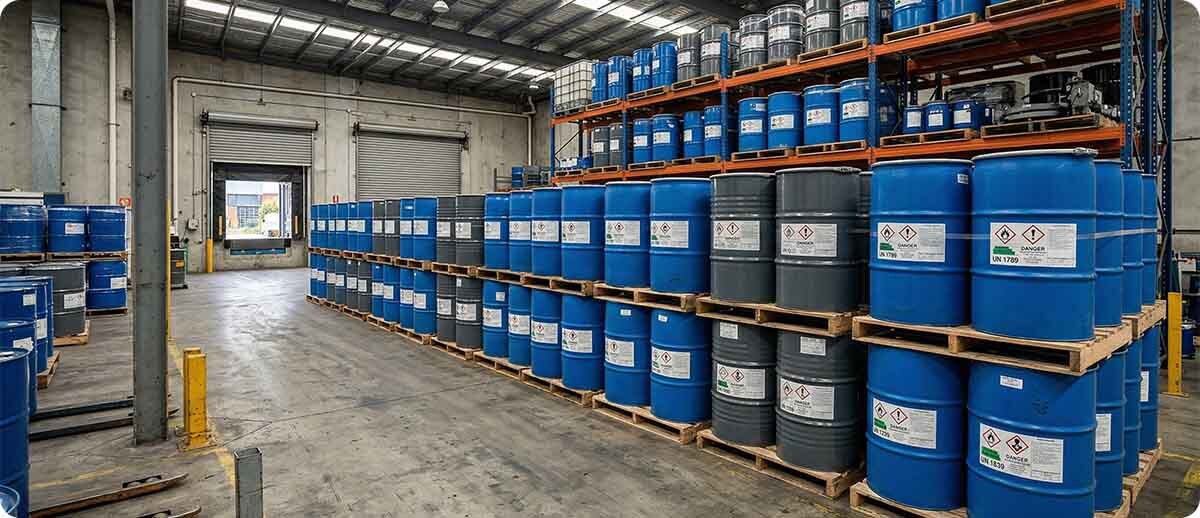
If your operation ships hazardous chemicals by sea, the GHS label on your drum has one job when things go wrong: stay on, stay readable, and stay there for three months in the ocean. Not in a climate-controlled warehouse. Not on a sheltered loading dock. In seawater — submerged, abraded by sand and wave action, and exposed to UV — for 90 days.
That's what BS5609 actually tests. And the number of chemical operations using label materials and print systems that haven't passed that test — despite believing they're compliant — is significant. The reasons range from misunderstanding what BS5609 certifies, to selecting a label material that passed Part 2 of the standard but never pairing it with a print system certified under Part 3, to simply defaulting to whatever thermal transfer ribbon was already in stock without checking whether it's been tested for marine environments.
This guide covers what BS5609 actually requires, where operations most commonly fall short, and what a compliant label system looks like in practice — from the substrate to the print method to the ink.
What BS5609 Actually Tests — and Why the System Concept Matters
BS5609 is a British Standard that has been adopted internationally as the benchmark for pressure-sensitive GHS labels used on hazardous chemical containers transported by sea. Its authority comes from international maritime law — the International Maritime Dangerous Goods (IMDG) Code and the UN Globally Harmonized System of Classification and Labelling of Chemicals (GHS) both require that labels on marine-transported dangerous goods containers remain identifiable after immersion in seawater for three months.
The standard has four parts, but the two that determine compliance for most operations are Part 2 and Part 3.
Part 2 — Label Stock Certification. Part 2 tests the base label material itself — the facestock and adhesive — against marine exposure conditions. Testing is conducted on both aluminium and HDPE (high-density polyethylene) panels, which represent the two primary drum surfaces used for chemical containers. The tests include accelerated artificial salt spray, accelerated artificial sunlight (UV) exposure, temperature cycling, dimensional stability testing, and adhesion testing after marine exposure. A label material that passes Part 2 is certified as suitable for marine use as a substrate — but this certification says nothing about what happens when you print on it.
Part 3 — Printed Label Certification. Part 3 tests the complete printed label — the label stock combined with a specific print technology and specific ink or ribbon. The reason Part 3 exists as a separate test is straightforward: ink and substrate interact. The same label material can produce dramatically different results depending on how it's printed and with what. A resin ribbon that survives seawater immersion on one substrate may degrade on another. An inkjet system certified with one ink formulation is not certified with a different ink, even from the same manufacturer.
Part 3 testing includes print permanence testing, abrasion resistance after saltwater exposure, and legibility evaluation — including barcode readability. The core requirement is that labels must remain adhered and legible after three months of seawater immersion. Real-world testing is sometimes conducted by placing labelled test blocks in an ocean test site at mid-tide for the full 90-day period. Accelerated laboratory testing involving salt spray and UV exposure is also accepted under certain protocols.
The critical implication: a label material that has passed Part 2 is not a BS5609 compliant label. It is only a BS5609 compliant label when printed with a specific ink or ribbon system that has also passed Part 3 testing as a certified combination. Buying a Part 2-certified substrate and printing it with an uncertified ribbon does not produce a compliant label — it produces a label printed on a substrate that would have passed the test if printed correctly.
The GHS Color Problem: Why Thermal Transfer Alone Isn't Enough
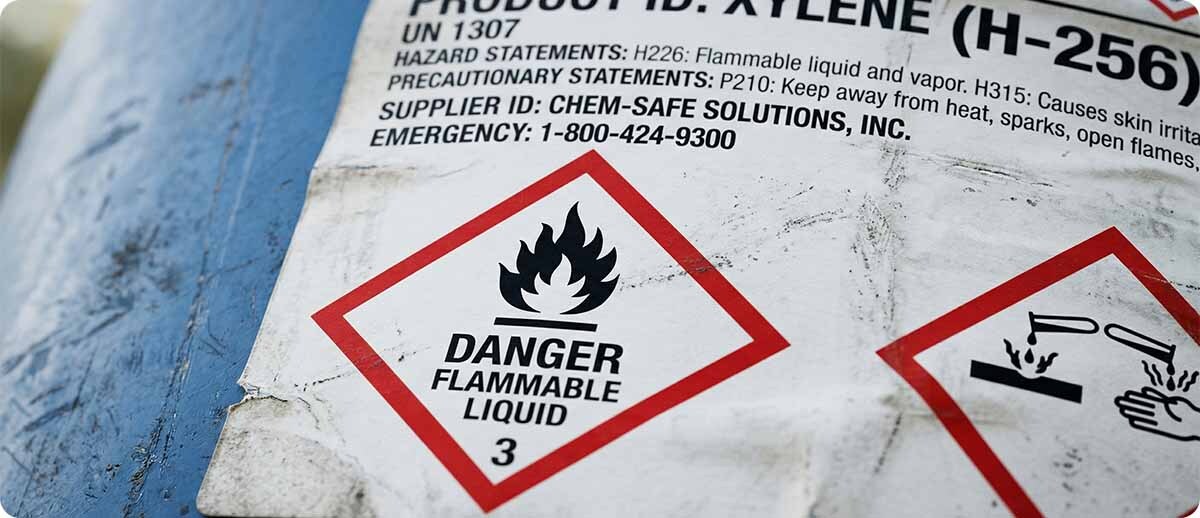
GHS labels have a specific visual requirement that creates a printing challenge standard thermal transfer systems can't easily address: the hazard pictogram diamonds require a red border. GHS pictograms — the flame, skull and crossbones, exclamation mark, corrosion symbol, and others — are printed in black inside a white diamond with a red border on a white background.
Standard single-head thermal transfer printers print black ink only. Getting the red diamond border requires one of three approaches: pre-printed label stock with the red diamond already on the substrate (which limits flexibility and requires large inventory management), a two-head thermal transfer printer that runs black and red resin ribbons simultaneously, or a full-color inkjet system that prints the complete label including the red border in a single pass.
Each approach has its tradeoffs in terms of cost, flexibility, and BS5609 compliance pathway. But the most practical on-demand solution for chemical operations that need to print variable GHS labels — different products, different hazard classifications, different lot numbers — is a full-color inkjet system using BS5609-certified label stock and certified inks. This is exactly the system Brady has engineered around the BradyJet J7300.
The Brady BS5609 System: J7300 + J-261 Label Stock
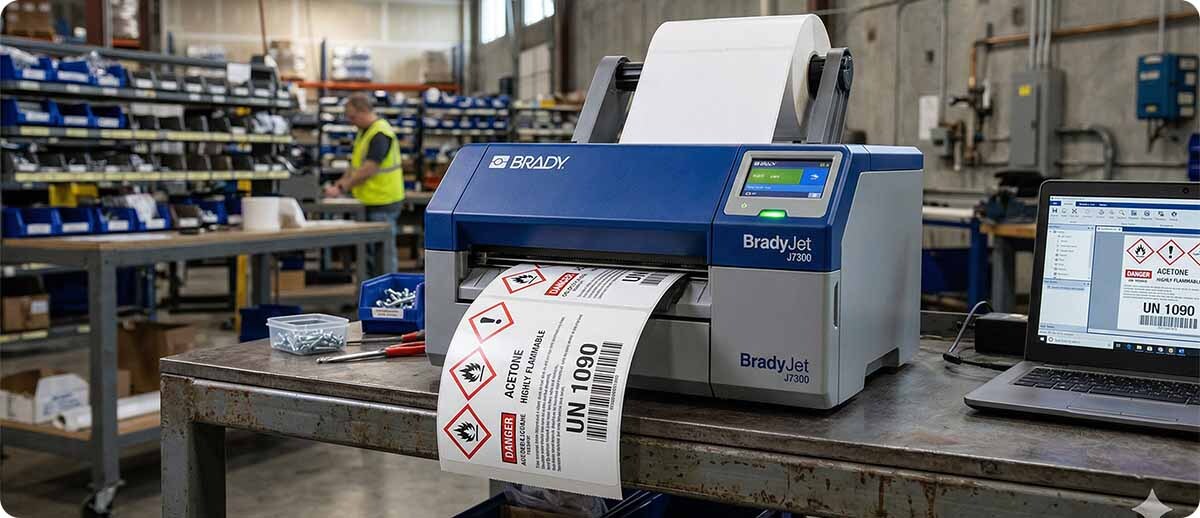
Brady has built their primary BS5609 compliance solution around the BradyJet J7300 color label printer paired with their BS5609-certified inkjet label materials. This is a tested system certification — the specific printer, ink formulation, and label stock have been tested together under BS5609 Part 3 conditions and the combination is certified compliant.
Brady BradyJet J7300 Color Label Printer
Part #: J7300-PWID (Product & Wire ID) | J7300-W-PWID | J7300-W-SFID (Safety & Facility)
Industrial-grade inkjet color label printer designed specifically for compliance labeling applications including GHS, hazmat, DOT, and marine chemical drum labels. LabelSense technology enables the printer, label materials, and ink cartridges to communicate automatically for setup, adjustment, and material recognition. Dual CMY and true black (K) ink cartridges produce vibrant full-color labels including the red diamond borders required for GHS pictograms — in a single print pass. Inks print smear-free on Brady's certified label stocks and resist water, chemicals, and abrasion. Brady's BS5609 compliance pathway is built on this system — the J7300 plus certified label stock is Brady's tested and documented route to compliant GHS drum labeling for marine shipment. Print Utility software provides job cost calculation, remote monitoring, and status alerts for print management in a production environment.
Shop the BradyJet J7300 →Brady J-261-2585 GHS / Marine / Chemical Drum Label
Part #: J-261-2585 | 2.95" x 4.33" | Roll of 300 | For use with BradyJet J7300
Brady's BS5609-rated inkjet label stock for the J7300 system. Explicitly listed for GHS, hazardous materials, drum labeling, marine shipment, transportation (DOT), storage, and pharmaceutical labeling. Built-in LabelSense technology enables automatic label recognition and setup when loaded into the J7300. The 2.95" x 4.33" format accommodates the full GHS label layout including all required elements: product identifier, signal word, hazard and precautionary statements, pictograms with red diamond borders, supplier information, and supplemental information. This is the label stock in Brady's certified J7300 BS5609 system — it is not intended for use with other printers or inks outside the certified combination.
Shop Brady J-261-2585 Labels →Brady J7300 Ink Cartridges — P-1CMY2K
Part #: P-1CMY2K | CMY + True Black | Pack of 3 Cartridges
BradyJet J7300 ink cartridges delivering the specific ink formulation used in Brady's BS5609 certified label system. CMY (Cyan, Magenta, Yellow) plus True Black (K) ink in a self-contained cartridge that drops into the J7300 with a single click. Designed specifically for the J7300's enhanced label topcoat — ink dries instantly on the certified label stock, resists smudging and smearing, and delivers the vibrant, accurate red color reproduction required for GHS pictogram borders. Holds up to 50% more ink than standard cartridges for longer runs and fewer changeovers. Using non-certified inks with Brady's BS5609 label stock voids the system's Part 3 certification — the ink is part of the tested combination, not interchangeable.
Shop J7300 Ink Cartridges →The Thermal Transfer Path: When and How It Works for GHS
Thermal transfer printing can achieve BS5609 Part 3 compliance — but only with the right ribbon on the right substrate, tested together. Most thermal transfer ribbons fail BS5609 testing. Wax ribbons and wax-resin ribbons don't survive three months of seawater immersion — the ink layer softens, dissolves, or abrades off under marine exposure. Full resin ribbon is the required formulation for any thermal transfer approach to BS5609 compliance.
Brady's R6000 halogen-free resin ribbon is their high-performance resin formulation for industrial and compliance labeling. It provides excellent solvent resistance, scratch resistance, and heat resistance when printed on appropriate Brady label stocks including polyester substrates. The R6000 is UL recognized on various Brady label stocks under UL file MH17154 — the same UL file that covers their compliance labeling systems.
Brady R6000 Halogen-Free Resin Ribbon
Part #: R6000 (2.36" x 984') | B30-R6000 (B30 cartridge format, 4.33" x 200') | multiple widths
Brady's halogen-free resin ribbon delivering excellent solvent, scratch, and heat resistance for industrial and compliance labeling on polyester and other smooth synthetic substrates. Recommended for Brady's B-483 Ultra Aggressive Polyester and B-423 Permanent Polyester label stocks. UL Recognized on various Brady label stocks under UL file MH17154. Compatible with Brady's BBP81, BradyPrinter i7100, PR Plus Series, and THT 3-inch core printers. For any thermal transfer approach to GHS chemical drum labeling requiring resin-level durability, the R6000 is Brady's certified formulation. The B30-R6000 cartridge format is for Brady's B30 series printers used in GHS label starter kits.
Shop Brady R6000 Resin Ribbon →For high-volume thermal transfer industrial label printing, Brady's BradyPrinter i7100 and i5100 industrial label printers are the platform. The i7100 is designed for the widest range of difficult-to-print materials including the polyester substrates required for chemical drum labeling, with print speeds suited to production-scale label output. The i5100 is the mid-volume counterpart for operations with moderate daily label volumes.
Brady BradyPrinter i7100 Industrial Label Printer
Part #: 149050 (300 dpi) | 149053 | 150773 (ESD cover) | 150775
Brady's heavy-duty industrial label printer rated for thousands of labels per day. Prints on the widest range of Brady materials including polyester, polyimide, and other difficult-to-print substrates used in compliance labeling. Available in 300 and 600 dpi configurations. Peel configuration available for automated label dispensing. Easy-load material system with Brady Workstation software suite included. For thermal transfer GHS chemical labeling at production scale — pairing the i7100 with Brady's resin ribbon and appropriate polyester label stock is the high-volume thermal transfer route to durable chemical drum labels.
Shop BradyPrinter i7100 →Getting Started: The Brady GHS Label Starter Kit
For operations setting up GHS chemical labeling from scratch on a B30 series printer, Brady's GHS starter kits provide the label materials and R10000 ribbon in a single package. The B30 platform is designed for moderate-volume labeling in safety, facility, and compliance applications.
Brady B30 GHS Label Starter Kits
Part #: 146072 | 146073
Everything needed to begin printing GHS labels on a Brady B30 series printer. Includes a variety of durable label materials with ultra-aggressive adhesive that withstand the elements indoors and outdoors, plus the tough R10000 ribbon formulated to produce smear-proof, long-lasting printed text capable of surviving years in industrial areas and outdoor conditions. These kits are the practical starting point for safety and compliance labeling programs on the B30 platform — providing compatible materials out of the box without requiring separate selection of label stock and ribbon. Two kit configurations available covering different label size and application combinations.
Shop Brady GHS Starter Kit (146072) → Shop Brady GHS Starter Kit (146073) →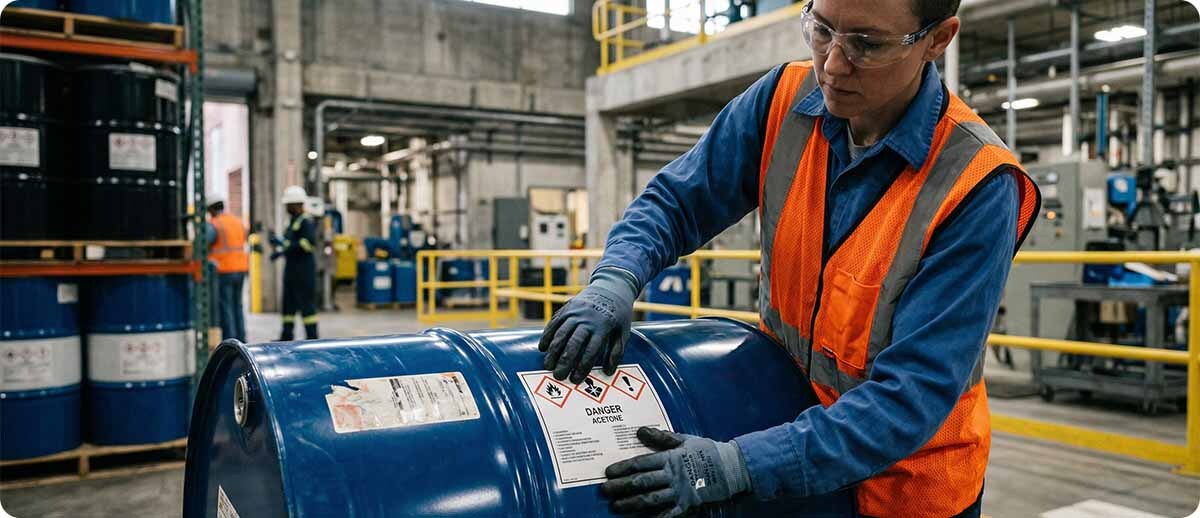
The Most Common BS5609 Compliance Failures
Most chemical operations that discover a BS5609 compliance gap do so at a bad time — during an audit, a customer review, or after a shipment is rejected. These are the failure modes that show up most often:
Using a Part 2-certified substrate with an uncertified print system. The label material passed the saltwater test on blank stock. But the ribbon used to print it hasn't been tested with that substrate under Part 3 conditions. The label looks compliant on paper but isn't — the ink layer is the weak point, not the substrate.
Using wax or wax-resin ribbon on polyester drum labels. This is the single most common thermal transfer failure mode. Wax ribbon produces an ink layer that seawater dissolves. The label stays on the drum. The print disappears. A wax-resin ribbon is somewhat better but still insufficient — full resin is the only thermal transfer formulation with the hardness and chemical resistance to survive sustained seawater exposure.
Printing GHS labels on paper stock. Paper fails the BS5609 Part 2 substrate test. Paper absorbs moisture, the adhesive degrades, and the label separates from the drum surface. Paper label stock is not a BS5609-compliant substrate regardless of how it's printed. Polyester facestock with a marine-grade permanent adhesive is required.
Substituting different ink brands in a certified inkjet system. If your J7300 is running the certified Brady J-261 label stock but you've loaded third-party ink cartridges, the Part 3 certification no longer applies. The ink is part of the tested combination. Third-party inks may or may not survive the test — but they haven't been tested, which means the label system isn't certified regardless of the substrate.
Applying labels to oily or contaminated drum surfaces without surface preparation. Even a perfectly specified BS5609 label system can fail adhesively if the drum surface is contaminated with release agents, oils, or moisture at the time of application. Clean the application surface with IPA before label application — contaminated surfaces are the most common cause of adhesive failure that has nothing to do with the label specification itself.
Frequently Asked Questions: GHS Chemical Labeling & BS5609
Does BS5609 apply to all GHS labels, or only labels on containers shipped by sea?
Strictly speaking, BS5609 is required for hazardous chemical containers transported by sea under IMDG and associated merchant shipping regulations. However, it's increasingly used as the durability standard for GHS labels in any demanding environment — outdoor storage, high-humidity operations, and chemical processing facilities — because the test criteria represent a robust proxy for long-term label durability beyond marine applications. If your customer specs require BS5609, or if your labels face sustained outdoor or chemical exposure, it's the appropriate benchmark regardless of shipping mode.
Can I use a standard desktop label printer for BS5609-compliant GHS drum labels?
Only if that specific printer, with a specific ink or ribbon, and a specific label stock, has been tested and certified as a combination under BS5609 Part 3. Standard desktop thermal transfer printers running wax or wax-resin ribbons on paper labels cannot produce BS5609-compliant labels regardless of the substrate used. The print system is part of the certification — there's no shortcut to Part 3 compliance without a tested combination.
We ship both domestically and internationally. Do we need BS5609 for domestic shipments?
For domestic road and rail shipment, DOT labeling requirements apply — which have their own durability standards but don't mandate BS5609 specifically. If any portion of your supply chain involves ocean freight, even if your facility's shipments are domestic to a port, the containers may move on vessels subject to IMDG requirements downstream. Many chemical manufacturers standardize on BS5609-compliant labels for all drum shipments rather than maintaining separate label systems by mode of transport — it simplifies compliance and provides consistent durability documentation.
How do I verify that my current label system is actually BS5609 compliant?
Contact your label and printer supplier and ask specifically: has the combination of this label stock, this printer, and this ribbon or ink been tested and certified under BS5609 Part 3? Ask for the certification documentation or test report. If they can't produce a Part 3 certification for your specific combination, your label system is not fully compliant even if the substrate has a Part 2 certification. Brady provides explicit BS5609 compliance documentation for their certified J7300 system.
Our GHS labels need to include a barcode for product tracking. Does BS5609 cover barcode readability?
Yes — BS5609 Part 3 includes legibility testing after marine exposure, which covers both text and barcode readability. A label that passes BS5609 must maintain readable barcodes after the test exposure conditions. This makes the choice of print resolution and barcode density relevant for compliance — dense barcodes printed at insufficient resolution may become unreadable after marine exposure even if the ink layer itself survives. Brady's J7300 system with the J-261 label stock is designed to maintain barcode readability through the certification test conditions.
GHS and BS5609 compliance comes down to having the right system in place — not just the right label material. If you're trying to verify your current setup, spec a new labeling system for chemical drum applications, or figure out where a compliance gap is coming from, our team can help you work through it. Fill out the form below and let's make sure your label system holds up — on the drum, in the audit, and if it ever ends up in the water.