
Direct Thermal vs. Thermal Transfer: The Real Cost Comparison Over a 3-Year Fleet Lifecycle
Posted by Thermal Printer Supplies on Apr 29th 2026

By Thermal Printer Supplies | Printer Fleet Management | Total Cost of Ownership Guide
The choice between direct thermal and thermal transfer printing is usually framed as a technology question. It is actually a cost question. The technology decision is straightforward once you know your application requirements. The cost question is harder because the total cost of ownership for a printer fleet over a multi-year lifecycle involves four separate drivers that interact with each other: media cost, ribbon cost, printhead wear rate, and the cost of label failures. Miss any one of them and your cost estimate is wrong, sometimes significantly wrong.
Fleet managers who choose direct thermal because it appears to have lower per-label costs sometimes discover, two years in, that the faded-label problem in their specific environment is generating reprint and relabeling costs that exceed what they saved on ribbon. Fleet managers who default to thermal transfer without running the numbers sometimes pay for ribbon, ribbon changes, and ribbon inventory on a fleet of low-volume printers where direct thermal would have been the less expensive option over the same period. The right answer depends on your specific numbers, not on a general rule.
This guide walks through each of the four TCO drivers with actual math frameworks, realistic cost ranges, and the variables that move the answer in each direction. At the end, there is a decision matrix that helps you apply the framework to your own fleet before talking to anyone about buying anything.
TCO Driver 1: Label Media Cost
Direct thermal label stock and thermal transfer label stock are not the same material at the same price. Direct thermal labels have a heat-sensitive coating on the face that reacts to the printhead directly. That coating adds cost to the facestock. Thermal transfer labels are coated differently, optimized to accept ink from a heated ribbon rather than react to direct heat. The two materials are priced differently, and the gap matters at volume.
In most standard label configurations, direct thermal label stock costs 15 to 40 percent more per label than an equivalent thermal transfer paper label at the same size and adhesive spec. The range is wide because it depends on facestock quality, adhesive type, top coating, and order volume. For a 4x6 shipping label in a common coated paper format, a realistic cost differential is in the range of 15 to 25 percent in favor of thermal transfer paper stock at high volumes.
The math at scale: a fleet of ten printers each printing 1,000 labels per day runs 2.5 million labels per year across the fleet. At a label cost differential of 0.002 dollars per label, that is $5,000 per year in higher media cost for the direct thermal option, or $15,000 over three years, before accounting for any other cost driver. That number alone does not make the decision, but it is material and most operations are not tracking it.
There are important exceptions. Synthetic direct thermal label stock, used for durable applications like outdoor asset tags or cold storage labels, costs significantly more than paper thermal transfer stock. Specialty thermal transfer materials for chemical drum labels, outdoor vinyl, and polyester also carry higher per-label costs than standard paper DT stock. The media cost comparison has to be done for the specific material types in your application, not for generic "DT" versus "TT" as categories.
Media Cost Estimate: 10 Printers, 1,000 Labels/Day Each, 3-Year Fleet
| Variable | Direct Thermal | Thermal Transfer |
|---|---|---|
| Labels per day (fleet) | 10,000 | 10,000 |
| Labels per year (fleet) | 2,500,000 | 2,500,000 |
| Estimated cost per label (4x6 paper) | $0.012 | $0.010 |
| Annual media cost (fleet) | $30,000 | $25,000 |
| 3-year media cost (fleet) | $90,000 | $75,000 |
Note: Label cost estimates are illustrative ranges based on typical market pricing for standard paper stock. Your actual pricing depends on label size, material spec, adhesive, and order volume. Use these as a framework, not as quotes.

TCO Driver 2: Ribbon Cost
Ribbon is the cost driver that makes direct thermal look cheaper at first glance. There is no ribbon to buy. There is no ribbon to change. There is no ribbon inventory to manage. For a small fleet printing low volumes, that simplicity has real value and the cost savings are real.
At higher volumes, ribbon cost per label is lower than the media cost advantage of thermal transfer. A standard Zebra 6000 wax ribbon at 4.33 inches wide and 1,476 feet long (06000BK11045) covers approximately 4,428 4x6 labels per roll at 100 percent coverage, or more at typical 50 to 60 percent coverage levels common in standard label designs. At typical wax ribbon pricing, ribbon cost per label on a 4x6 label runs approximately $0.002 to $0.005 per label depending on volume pricing and coverage percentage. That is the cost added to the thermal transfer per-label cost that direct thermal does not have.
The ribbon cost calculation also has to account for the labor of ribbon changes. A ribbon change on a desktop printer takes two to four minutes including threading, alignment check, and test print. At ten ribbon changes per day across a fleet of ten printers, that is 100 to 400 minutes of labor per day, or roughly one to two staff hours. Over 250 working days per year, that is 250 to 500 staff hours annually. At $18 to $22 per hour, that is $4,500 to $11,000 per year in ribbon change labor for the fleet, adding $13,500 to $33,000 over three years that does not appear in the per-label ribbon cost calculation.
The ribbon change labor number is the one most operations skip entirely. It only matters at high ribbon change frequency. For a printer changing ribbon once per week, the labor is negligible. For a printer changing ribbon twice per day, the labor compounds significantly over three years.
Zebra Thermal Transfer Ribbons at Thermal Printer Supplies
06000BK11045 — Zebra 6000 Wax, 4.33" x 1,476' (case) | Standard shipping, receiving, general warehousing
06000BK11045-EA — Zebra 6000 Wax, 4.33" x 1,476' (single roll)
06000BK06045 — Zebra 6000 Wax, 2.36" x 1,476' (case) | Narrow label applications
05095BK11045 — Zebra 5095 Full Resin, 4.33" x 1,476' (case) | Chemical, outdoor, synthetic label stock
05095BK08945 — Zebra 5095 Full Resin, 3.5" x 1,476' (case)
Shop Zebra Ribbons →TCO Driver 3: Printhead Wear Rate
This is the TCO driver that most operations overlook entirely, and it moves the math more than most people expect.
In thermal transfer printing, the ribbon passes between the printhead and the label surface. The ribbon acts as a lubricating barrier that reduces friction between the printhead elements and the media. The abrasion on the printhead comes from the ribbon backing, which is engineered to be smooth and consistent. This is a significantly gentler contact environment for the printhead than direct thermal printing.
In direct thermal printing, the label surface contacts the printhead elements directly. Label stock is more abrasive than ribbon backing, and the heat-sensitive coating on DT labels can leave residue on the printhead surface if cleaning is infrequent. The result is that direct thermal printheads wear faster than thermal transfer printheads at equivalent print volumes. Industry data and Zebra's own guidance consistently indicate that DT printhead life is shorter than TT printhead life under comparable operating conditions, with the gap commonly in the range of 30 to 60 percent faster wear on direct thermal.
Printhead replacement costs for common desktop and industrial printers run $150 to $600 depending on the model and DPI. A fleet of ten printers replacing printheads 30 to 60 percent more frequently over three years produces a meaningful cost difference. At an average printhead cost of $250 and an assumed replacement frequency of once every 18 months for thermal transfer versus once every 12 months for direct thermal, the three-year printhead cost per printer is $500 for thermal transfer versus $750 for direct thermal. Across ten printers, that is $2,500 in additional printhead cost for the direct thermal fleet over three years, before accounting for any labor involved in printhead replacement.
The frequency assumption above is conservative for low-volume operations and aggressive for high-volume operations. The variable to plug into your specific calculation is your actual daily print volume in linear inches per printer, compared against the printhead's rated life in linear inches. Zebra warrants its replacement printheads for 1 million linear inches or one year, whichever comes first. A printer running 4,000 linear inches per day reaches 1 million inches in 250 days. The same printer at 1,000 linear inches per day reaches 1 million inches in 1,000 days. The direct thermal version of each printer reaches those milestones faster.
Printhead Wear Rate: Estimated 3-Year Replacement Cost Comparison (10 printers, medium volume)
| Variable | Direct Thermal | Thermal Transfer |
|---|---|---|
| Est. printhead replacement interval | Every 12 months | Every 18 months |
| Replacements per printer over 3 years | 3 | 2 |
| Average printhead cost | $250 | $250 |
| Printhead cost per printer over 3 years | $750 | $500 |
| Total printhead cost, 10-printer fleet, 3 years | $7,500 | $5,000 |
TCO Driver 4: Label Failure Cost
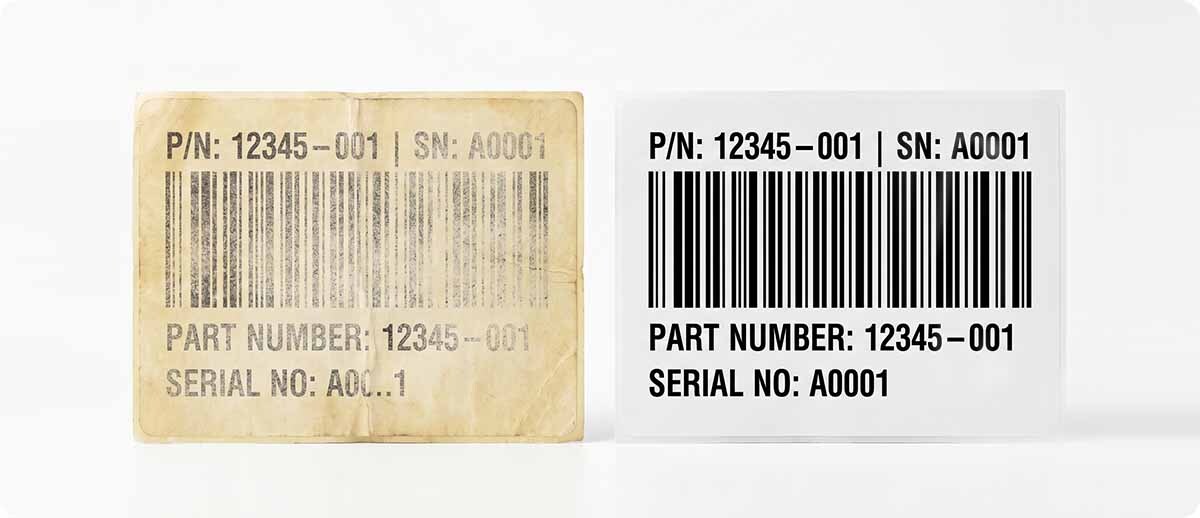
This is the one that is hardest to estimate in advance and most expensive to discover after the fact. Direct thermal labels fade. The heat-sensitive coating that makes the label print without a ribbon is also sensitive to other forms of energy, specifically UV light, ambient heat above approximately 150 degrees Fahrenheit, and contact with certain chemicals. When a direct thermal label is exposed to these conditions, the image degrades. The barcode becomes unreadable. The human-readable text becomes illegible.
In the right application, this is not a problem. A shipping label on a package that moves from the print station to the carrier in under 24 hours does not need to survive UV or heat exposure. The label does its job and is no longer needed. Direct thermal is correct for that application and the fading issue is irrelevant.
In the wrong application, the failure cost can be significant. Consider each of the following scenarios that operations encounter:
Outdoor staging areas and yard storage: A pallet of product labeled with direct thermal labels sits in an outdoor staging area for 48 hours in summer. The label has faded enough that the barcode does not scan on the first attempt, requiring manual entry or relabeling. At five seconds per manual entry and 500 affected pallets per month, that is 2,500 seconds of extra labor per month and 30,000 seconds per year, or roughly 8 hours of additional labor annually per ten printers in this environment. The hidden cost is real even before accounting for any failed scans that result in inventory errors.
Warm environments and near heat sources: Products stored near boilers, in uninsulated warehouses during summer, or on factory floors near ovens and heating equipment see ambient temperatures that accelerate DT label degradation. Labels applied during receiving may be unreadable by the time the product reaches shipping, requiring relabeling before outbound. Relabeling cost includes the label itself, the labor to remove and reapply, and the downtime while product waits for the relabeling operation.
Chemical environments: In food processing, chemical manufacturing, and agricultural operations, direct thermal labels exposed to cleaning agents, misting, and chemical contact degrade rapidly. A label applied at receiving may be unreadable within hours in a wet or chemical-heavy environment. Operations that have discovered this problem after deploying direct thermal in the wrong environment often underestimate how much of their relabeling labor and scan failure rate is attributable to the label choice rather than to worker error or equipment malfunction.
Long-duration asset and inventory labels: Labels intended to remain readable for 12 months or more, such as fixed asset tags, bin labels, and long-cycle inventory labels, will typically fail before their intended service life on direct thermal stock without a protective top coat. The cost of relabeling a warehouse worth of bin labels because DT labels faded can run well into five figures depending on facility size.
Thermal transfer labels printed with appropriate ribbon do not have this failure mode. A wax ribbon on coated paper stock produces a label that is stable under normal warehouse conditions, UV resistant, and not affected by most common chemicals. A resin ribbon on synthetic stock produces a label that survives years of outdoor exposure, chemical immersion, and extreme temperature cycling. The thermal transfer image is mechanically transferred to the label surface and does not degrade from environmental exposure the way a heat-activated DT coating does.
Estimating the label failure cost for your operation requires knowing your average label service life requirement, your environment's UV and heat exposure level, and your current relabeling frequency. Many operations that have never tracked relabeling as a separate cost category discover, when they do track it, that it represents a meaningful percentage of their total labeling cost.
The 3-Year TCO Summary: Putting It All Together
Using the 10-printer, 1,000-labels-per-day fleet example with medium daily volume, here is how the four cost drivers accumulate over three years, before label failure costs which vary too much by environment to generalize:
| Cost Driver | Direct Thermal (3 yr) | Thermal Transfer (3 yr) | Difference |
|---|---|---|---|
| Label media cost | $90,000 | $75,000 | DT costs $15,000 more |
| Ribbon cost | $0 | ~$12,500 | TT costs $12,500 more |
| Ribbon change labor | $0 | ~$9,000 | TT costs ~$9,000 more |
| Printhead replacement | $7,500 | $5,000 | DT costs $2,500 more |
| Label failure / relabeling | Varies by environment | Near zero | DT risk varies $0 to $30,000+ |
| Estimated 3-year total (excluding label failure) | $97,500 | $101,500 | TT costs ~$4,000 more before label failures |
The summary table reveals something counterintuitive for many buyers: when you include all four drivers, direct thermal and thermal transfer are much closer in total cost than the "no ribbon" savings suggest. At medium volume with standard paper labels, the thermal transfer premium over three years is roughly $4,000 across a ten-printer fleet before you add any label failure cost. In an indoor, controlled environment with short label service life requirements, direct thermal is the financially sensible choice. In any environment with UV exposure, heat, chemicals, or label durations over 30 days, the label failure cost column tips the total in thermal transfer's favor.
The Decision Matrix: Which Technology Wins for Your Operation
| Application Condition | Recommended Technology | Reason |
|---|---|---|
| Label service life under 30 days, indoor controlled environment | Direct Thermal | No ribbon cost, no failure risk in this environment, lower TCO |
| Label service life 30 to 90 days, indoor warehouse, some UV exposure possible | Thermal Transfer | DT fading risk at this duration outweighs ribbon cost |
| Outdoor staging, yard storage, or seasonal outdoor exposure | Thermal Transfer | UV and heat destroy DT image reliability within days to weeks |
| Near heat sources, temperatures regularly above 150°F | Thermal Transfer | DT coating activates and darkens at elevated temperatures |
| Chemical environments, cleaning agents, food processing | Thermal Transfer | Chemical contact degrades DT coating; TT with resin ribbon is resistant |
| High volume, above 2,000 labels per printer per day | Thermal Transfer | Printhead wear differential compounds significantly at high volume |
| Low volume, under 500 labels per printer per day, short service life | Direct Thermal | Ribbon cost and change labor exceed media cost premium at low volumes |
Printers at Thermal Printer Supplies for Both Technologies
TPS carries both direct thermal only and dual-mode (DT and TT) printers across desktop and industrial classes from Zebra, Honeywell, and TSC. Most of the dual-mode industrial printers support both technologies with a simple configuration change, so if your fleet needs are mixed across zones or applications, a single printer model can serve both environments.
Zebra ZD421 Desktop Printer — Direct Thermal and Thermal Transfer Models
ZD4A042-D01M00EZ — Direct thermal, 203 DPI, USB, Bluetooth
ZD4A042-D01E00EZ — Direct thermal, 203 DPI, USB, Ethernet, Bluetooth
ZD4A042-301M00EZ — Thermal transfer, 203 DPI, USB, Bluetooth
ZD4A042-301E00EZ — Thermal transfer, 203 DPI, USB, Ethernet, Bluetooth
ZD4A043-301E00EZ — Thermal transfer, 300 DPI, USB, Ethernet, Bluetooth
ZD4A043-301W01EZ — Thermal transfer, 300 DPI, USB, Wi-Fi, Bluetooth
Shop Zebra Desktop Printers →Zebra ZT411 Industrial Printer — Direct Thermal and Thermal Transfer
ZT41142-D910000Z — Direct thermal, linerless, 203 DPI
ZT41142-T010000Z — Thermal transfer, 203 DPI
ZT41143-T010000Z — Thermal transfer, 300 DPI
Shop Zebra ZT411 →TSC Printronix DA210 / DA310 — Direct Thermal Desktop
99-158A001-0001 — DA210 direct thermal, 203 DPI, 6 ips
99-158A007-0201 — DA310 direct thermal, 300 DPI, 6 ips
Best suited for controlled indoor environments, shipping labels, and short-duration labeling applications where DT is appropriate based on the decision matrix above.
Shop TSC DA Series →
Frequently Asked Questions
We are currently using direct thermal for everything. How do we know if we have a fading problem?
The easiest diagnostic is to pull labels that have been applied for 30, 60, and 90 days in your actual operating environment and test them on your scanners. If first-scan success rate drops measurably on older labels, fading is contributing to your scan failure rate whether or not workers are reporting it. Also ask your receiving team how often they manually enter data from labels they cannot scan. That number is your fading cost in labor terms, even if nobody has connected it to the printing technology.
Can we use a top-coated direct thermal label to solve the fading problem and avoid thermal transfer?
A protective top coat on a direct thermal label improves resistance to abrasion and some chemical contact, and it extends UV and heat resistance somewhat. It does not eliminate the vulnerability. A top-coated DT label lasts longer than an uncoated one, but it still fades faster than a thermal transfer label with a wax ribbon under the same environmental conditions. Top-coated DT stock also costs more than standard DT stock, which narrows the media cost advantage. For environments with significant UV or heat exposure, top coating is a partial mitigation and thermal transfer is a more complete solution.
Our operation has some zones that need DT and some that need TT. Do we need different printers for each zone?
Not necessarily. Most Zebra and Honeywell industrial printers that support thermal transfer also support direct thermal operation, because direct thermal is simply thermal transfer without a ribbon installed. If you load direct thermal media and remove the ribbon, the printer operates in direct thermal mode. This means a thermal transfer printer can serve both application types depending on what media and ribbon you load, while a direct thermal only printer cannot be converted to thermal transfer. Speccing thermal transfer capable printers across a mixed fleet gives you the flexibility to adjust as your application requirements change.
How significant is the printhead wear difference in practice?
It is most significant at high daily print volumes. For a printer doing 500 labels per day, the printhead wear differential between DT and TT may extend replacement from every 24 months to every 30 months, which is not operationally significant. For a printer doing 3,000 labels per day, the same proportional difference might mean replacement every 8 months versus every 12 months, which is a meaningful cost and maintenance difference over a 3-year fleet cycle. Run your actual daily volume in inches against the printhead's rated million-inch life to see where you fall.
If you want to run the actual numbers for your fleet before making a media or printer decision, our team can help you work through the cost model with your specific label sizes, daily volumes, and environment. Fill out the form below and we will help you build the comparison that actually reflects your operation.