
Stop the Bleeding: The 2026 Guide to Retail Labeling Requirements and Chargeback Prevention
Posted by Thermal Printer Supplies on Feb 23rd 2026

A shipping label is no longer just a digital handshake; in 2026, it is the only thing standing between your inventory and a "Refusal at Dock" notification. Retailers have spent the last two years hyper-automating their sorting centers, and their tolerance for manual intervention has hit zero.
As of January 1, 2026, Amazon officially discontinued all in-house prep and labeling services for U.S. sellers. This shift places the entire burden of GS1 validation and placement accuracy squarely on the brand owner or reseller. Furthermore, the "Vendor Non-Compliance" fine has evolved from a flat fee into a performance-based penalty that can jeopardize your "Buy Box" eligibility or "Pro Seller" status. If your barcode doesn't scan in 1.5 seconds, you are being charged for the human labor required to fix it.
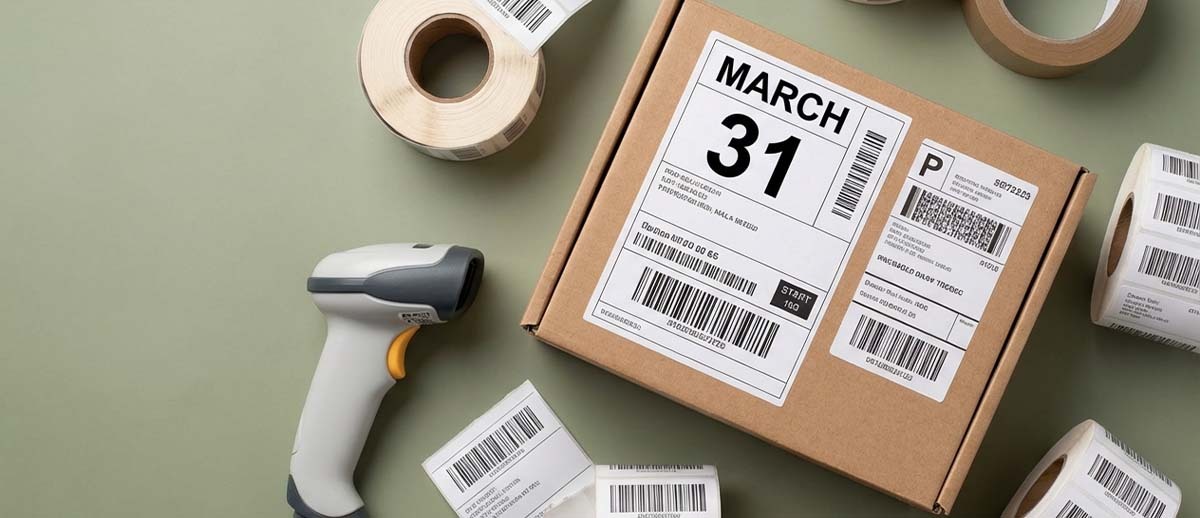
The March 31st Barcode Mandate: What Resellers Must Know
If you are a reseller (non-brand owner) on Amazon, the most urgent change in 2026 is the March 31 deadline. After this date, Amazon will no longer allow resellers to use manufacturer barcodes (UPCs) for pooled inventory. Every single unit must carry a unique Amazon Barcode (FNSKU).
For brand owners, the stakes are equally high. Amazon now enforces GS1 Validation at the point of inbound. If the GTIN on your shipping label does not perfectly match the GS1 GEPIR database entry for your brand prefix, the shipment will be flagged as a defect before it even leaves the receiving dock. This automated cross-referencing is designed to purge counterfeit or "recycled" UPCs from the marketplace. If you bought your barcodes from a third-party "discount" site years ago, 2026 is the year those codes will likely trigger a full shipment rejection.
Mastering Label Geometry and the "Quiet Zone"
The most frequent cause of retail chargebacks in 2026 isn't the data on the label—it’s the physical geometry of where it sits on the box. Automated overhead scanners require a specific amount of "white space" to calibrate the laser and identify the start and end of a data string.
The 0.25-Inch Rule
You must maintain a minimum of 0.25 inches (6.4mm) of "Quiet Zone" on the left and right of every barcode. This is non-negotiable. If your branding, box art, or even a stray piece of decorative tape encroaches on this space, the scanner will fail to "lock" on the code.
The "Seam" Trap and Refraction
Scanners in 2026 use high-frequency infrared. If a barcode is placed over a box seam or a piece of clear tape, the light refracts. To a human, the barcode looks fine; to a high-speed sensor, the refraction creates a "ghost" image or a "no-read" error. Never place a label where a box flap meets the body, and never "protect" a thermal label by taping over it. The adhesive in clear tape reacts with thermal paper over time, often turning the barcode invisible by the time it reaches a humid fulfillment center in Tennessee or California.
Thermal Bleeding and DPI Standards
Ensure you are printing at a minimum of 300 DPI. Most entry-level desktop thermal printers default to 203 DPI. While this is fine for a standard mailing label, it causes "picket-fencing" on dense GS1-128 barcodes. This is where the black bars bleed slightly into the white spaces. To a high-speed scanner, this "bleeding" changes the numerical value of the barcode entirely, leading to "Item Not Found" errors and immediate non-compliance fees.
Retailer-Specific Compliance Standards for 2026
Amazon FBA: The FNSKU and SIPP Shift
For Amazon, the primary requirement is now the FNSKU (Fulfillment Network Stock Keeping Unit). This label must be printed on non-reflective white paper with removable adhesive. If your product falls under the 2026 SIPP (Ships in Product Packaging) expansion, the label must be applied to the exterior of the retail box. However, it must be placed in a way that does not obscure safety warnings, lithium battery icons, or country-of-origin markings. Failure to comply with SIPP labeling can result in a "Packaging Fee" penalty ranging from $1.51 to $4.04 per unit, essentially erasing the savings of not using an overbox.
Walmart WFS: The SSCC-18 Standard
Walmart’s fulfillment service (WFS) heavily penalizes "un-scannable" cartons. They require a GS1-128 label that includes a 20-digit SSCC-18 barcode. This serves as a unique "license plate" for the carton. If the barcode is damaged or poorly printed, Walmart assesses a $5.00 fee per unit for manual reprocessing. Furthermore, Walmart requires the "Human Readable" portion of the barcode to be printed in a minimum 10-point Sans Serif font directly below the bars. This ensures that if the laser fails, the manual entry process is fast.
Target: The Human-Readable Audit
Target’s logistics centers have shifted focus toward "manual fallback" efficiency. While they use top-tier automated sorters, their 2026 compliance guide mandates that the text below a barcode must be perfectly legible. If their system fails to scan a code and a human worker cannot clearly read the PO number or the destination zip code due to low ink or smudging, the entire shipment is flagged for an "Audit Fail" and can be returned to the vendor at the vendor’s expense.
Actionable Strategy: Building an "Audit-Ready" Workflow
To move from reactive to proactive, your warehouse team needs a "Pack and Scan" protocol. Do not rely on visual confirmation; human eyes cannot detect a 299 DPI print error or a slightly skewed GS1-128.
Step 1: The Pre-Seal Scan
Before a carton is taped shut, the packer must scan the individual unit's FNSKU and then the outer carton’s SSCC. This "marriage" of data ensures that your Advanced Shipping Notice (ASN)—the digital twin of your shipment—is 100% accurate. In 2026, an ASN mismatch is the #1 trigger for massive retailer chargebacks. If the computer expects 24 units but the label says 12, the system will flag the entire pallet for a manual audit, and the fees will start mounting by the hour.
Step 2: Palletization Precision
For LTL (Less Than Truckload) shipments, the GS1-128 label placement is your highest risk factor.
- The Two-Side Rule: Apply labels to at least two adjacent sides of the pallet. This ensures that no matter which way the forklift approaches, a scan is possible.
- The Right-Side Bias: Labels should be placed on the right-hand side of the pallet face, roughly 32 inches from the floor. This "eye-level" placement for forklift-mounted scanners allows for "drive-by" scanning, which is the gold standard for 2026 logistics.
- Avoid the Wrap: Never place a label under the stretch wrap if the wrap is highly reflective or "cloudy." This will trigger a manual reprocessing fee nearly every time. If you must wrap over the label, use "low-gloss" logistics wrap designed for automated warehouses.
Step 3: The "Tape Test" for Ink Integrity
Before shipping a new batch or switching label suppliers, perform a physical ink audit. Take a piece of clear packing tape and press it firmly over a printed thermal label, then rip it off quickly. If the ink lifts or the image fades, your thermal settings are too low, or your ribbon is incompatible with the label stock. In the heat of a delivery truck, that label will "ghost" or fade. By the time it reaches the fulfillment center, it will be a blank white sticker—and a guaranteed fine.

The Label as a Profit Center
In the 2026 e-commerce landscape, logistics is no longer a back-office function; it is a competitive advantage. Sellers who master the "boring" details of GS1-128 placement, FNSKU quiet zones, and 300 DPI print clarity are the ones who will protect their margins from the death-by-a-thousand-cuts that is "Vendor Non-Compliance."
Treat your shipping label with the same respect you treat your product photography. One drives the click; the other ensures you actually get to keep the money from the sale.