
RFID vs. Barcoding: When Does the ROI Finally Make Sense?
Posted by Thermal Printer Supplies on Feb 8th 2026
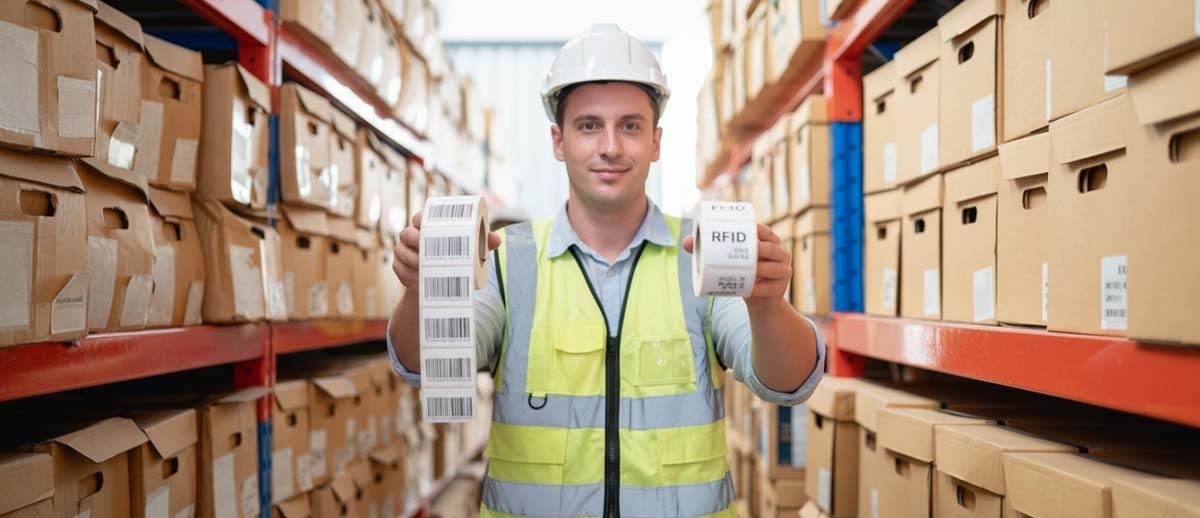
For decades, the humble barcode has been the undisputed king of the warehouse. It is cheap, reliable, and understood by every worker from the receiving dock to the front office. However, as supply chains move faster and consumer expectations for real-time accuracy reach an all-time high, many businesses are hitting a "performance ceiling" with traditional labeling.
You may have heard the success stories of giant retailers taking full-store inventories in minutes rather than days using Radio Frequency Identification (RFID). But for the average mid-sized operation, the jump from a one-cent barcode to a ten-cent RFID tag feels like a financial chasm. RFID implementation isn't just about buying new stickers; it involves specialized printers, handheld and fixed readers, middleware integration, and a fundamental shift in how your team handles data.
The question isn't whether RFID is "better" than barcoding—it technically is—but rather: When does that technical superiority actually translate into a profitable Return on Investment (ROI)? To find the answer, we need to look past the hype and examine the operational "Maturity Model" that dictates when a business has outgrown the barcode.
The Inventory Maturity Model: Where Do You Sit?
Most businesses follow a predictable path in their data capture journey. Understanding where you sit on this spectrum is the first step in determining if you are ready for the RFID "graduation."
- Level 1: The Manual Baseline At this stage, your team relies on paper manifests or manual entry. Barcoding is the obvious next step here. If you aren't yet scanning barcodes, RFID is likely overkill. Your ROI will be highest by simply digitizing your current manual chaos into a standard barcode system.
- Level 2: Optimized Barcoding You have a Warehouse Management System (WMS), and every item has a label. You are achieving roughly 80% to 85% inventory accuracy. This is the "sweet spot" for most small-to-medium businesses. Barcodes are working, but you still have to touch every single item to scan it.
- Level 3: The Performance Ceiling This is where the ROI conversation shifts. You are scanning barcodes, but your labor costs are ballooning. You might find that despite your best efforts, inventory accuracy is stuck at 90% because of human error or "missed scans." If your team spends more time walking and scanning than they do fulfilling orders, you have reached the barcode ceiling.
- Level 4: RFID-Driven Automation At this level, "line-of-sight" is your enemy. You need to verify an entire pallet of 50 mixed cartons in three seconds as it passes through a dock door. You need 99% accuracy because you are selling across multiple channels (Amazon, Shopify, and brick-and-mortar) and cannot afford a stockout. This is where RFID ROI becomes undeniable.

The Cold, Hard Truth About RFID Costs
Let’s address the elephant in the room: RFID is expensive. While a standard thermal transfer barcode label costs less than a penny, a passive UHF RFID tag—which contains a tiny silicon chip and an antenna—typically starts around $0.08 to $0.15 for high-volume paper labels and can climb to $1.00 or more for "on-metal" ruggedized tags.
The hardware gap is equally significant. A quality industrial barcode scanner might cost $300, whereas a ruggedized RFID handheld can easily reach $2,500 to $4,000. Then there is the infrastructure. To get the "magic" of automated tracking, you need fixed readers and antennas at "portal" locations like dock doors, which can cost $5,000 to $10,000 per portal including installation and tuning.
Finally, there is the software "middleware." RFID generates a massive amount of data. If a reader scans 1,000 tags in a second, your ERP system needs a way to filter those "pings" so it doesn't crash. Custom development and integration with your existing WMS are often the most overlooked costs in an RFID project.
When Does RFID Truly Outshine the Barcode?
Despite the higher price tag, RFID wins when the cost of "not knowing" is higher than the cost of the tag. There are three specific scenarios where the barcode simply cannot compete.
- High-Speed Bulk Processing Imagine a shipment of 200 electronics components arriving in a single crate. To scan barcodes, a worker must open the box, pick up every item, find the label, scan it, and put it back. This takes 20 minutes. With RFID, a fixed reader or a quick wave of a handheld scans all 200 items through the cardboard in under five seconds. If you process hundreds of these shipments a day, the labor savings alone pay for the RFID tags in months.
- Error-Prone Environments and "Hidden" Inventory Barcodes require a human to find a label. If a label is turned toward the wall or buried at the bottom of a stack, it doesn't exist to the system. RFID doesn't care about orientation. Because radio waves can pass through most non-metallic materials, "invisible" inventory becomes visible. If your business suffers from frequent "lost" stock that shows up months later in a corner, RFID is the solution.
- Compliance and High-Stakes Traceability In industries like healthcare, aerospace, or automotive, a missing part or an expired medication isn't just an inconvenience—it’s a liability. RFID can store far more data than a standard 1D barcode, including expiration dates and batch numbers that can be updated "on the fly" without printing a new label.
5 Questions to Determine Your RFID Readiness
Before you pull the trigger on an RFID pilot program, sit down with your operations team and answer these five questions honestly. If you answer "Yes" to three or more, it’s time to move past the barcode.
- Is your current inventory accuracy below 95% despite having a barcode system? If barcodes aren't giving you the accuracy you need, the problem is likely "human touch." RFID removes the human element from the scan, pushing accuracy toward 99.9%.
- Does it take your team more than 48 hours to complete a full physical inventory count? If counting stock shuts down your operations for days, you are losing revenue. RFID can typically reduce inventory count times by 75% to 90%.
- Are you facing "Compliance Chargebacks" from major retailers or distributors? Many big-box retailers now mandate RFID tagging. If you are paying fines for labeling errors or shipping discrepancies, the "expensive" RFID tag is actually the cheaper option.
- Do your items spend a significant amount of time "in transit" within your own facility? If items get lost between receiving, staging, and shipping, you need real-time visibility. RFID portals can track the movement of goods between zones automatically, creating a digital breadcrumb trail.
- Is the "Labor Cost" of your scanning process higher than the "Material Cost" of your labels? Calculate how many hours your staff spends scanning items one by one. If that labor cost is significantly higher than the projected $0.10 per RFID tag, the ROI is already there waiting for you.
The Hybrid Approach
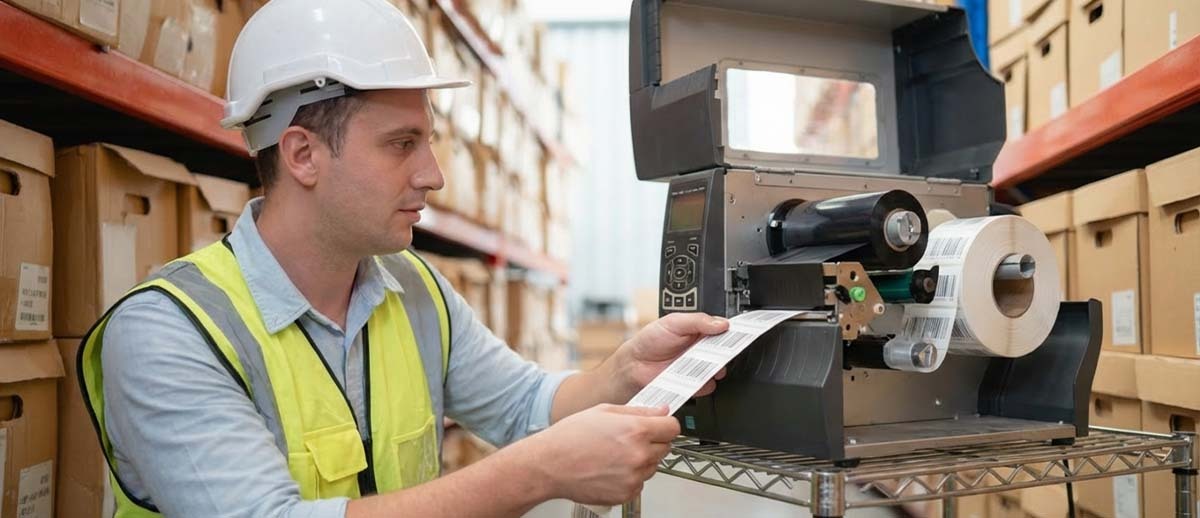
For many businesses in 2026, the answer isn't "RFID or Barcoding"—it’s both. This is known as a hybrid strategy. You might use low-cost barcodes for shipping labels and external compliance while using RFID for internal high-value asset tracking or work-in-process (WIP) monitoring.
RFID is no longer a futuristic luxury for the Fortune 500. It is a maturing tool for any business that has hit the physical limits of what a human with a barcode scanner can achieve. If your growth is being throttled by "slow data," it’s time to stop looking at the cost per tag and start looking at the cost of your limitations.